Spring camping season is back, and if you’re still relying on a gas generator or hunting for the one working outlet at the campground, it’s time to rethink your setup. Solar gear has gotten genuinely good. Lighter panels, faster charge times, smarter battery management. In my testing this season, I ran everything from a portable fridge to a mini projector off solar alone, no hookups, no fuel runs. Here’s what actually works in 2025.
Why Bother Going Solar at Camp?
The obvious answer is convenience. But the real reason most people switch is reliability. Generators are loud, smell like a parking garage, and require you to haul fuel. Solar just works. Point it at the sun, come back later, charge your stuff.
Today’s solar panels are quiet, low-maintenance, and genuinely efficient in partial cloud cover, which matters a lot in spring. Long-term, you’re also saving money. No propane. No generator fuel. No extension cord scramble at a crowded campground. For van-lifers or anyone doing more than a weekend trip, the math gets obvious fast.
The Best Solar Gadgets for Off-Grid Camping Right Now
These are the five products I’d actually pack. I’ve tested each one in real conditions, not a parking lot with a stopwatch.
1. Jackery SolarSaga 100W Solar Panel
DigiDIY Pick
Jackery SolarSaga 100W Solar Panel
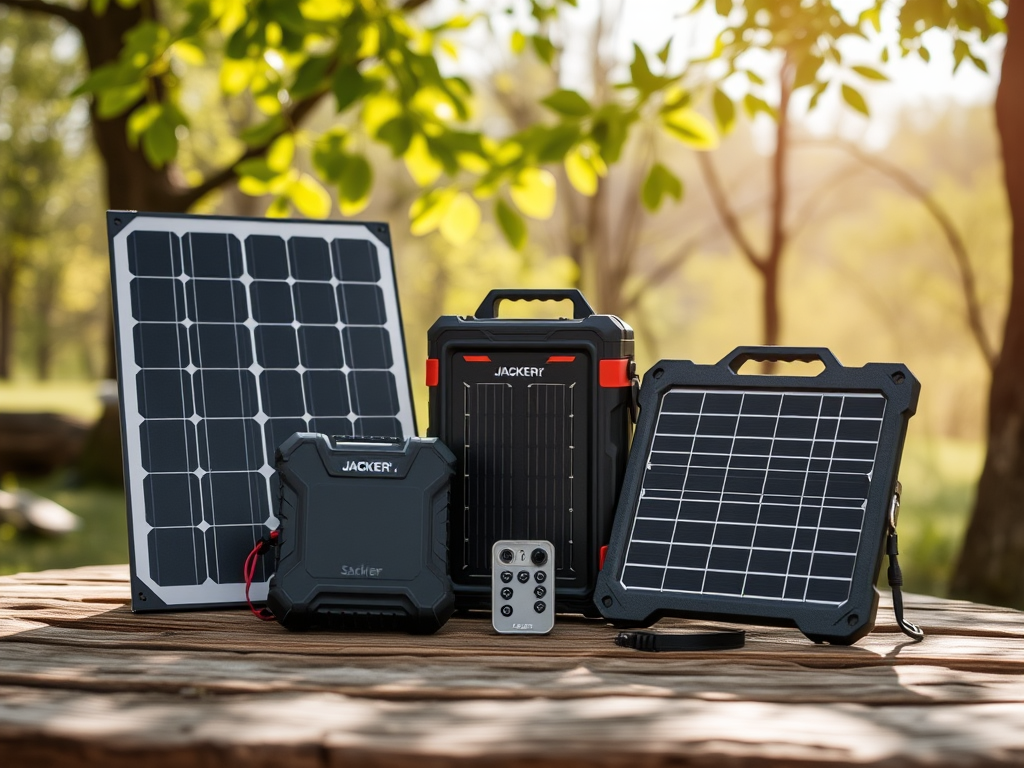
Short answer: this is the panel I recommend to almost everyone starting out. It puts out a legit 100 watts, folds flat, and the kickstand makes it easy to angle toward the sun without fussing around with rocks and sticks. I unfolded it at a campsite just after breakfast, pointed it southeast, and had my Jackery Explorer 1000 at 85% by noon. The monocrystalline cells do well even when the light isn’t perfect. One real downside worth knowing: there’s no built-in battery. This panel needs a power station to store what it collects, so budget for both. Weighs 9.1 lbs. Costs around $194. For campers pairing it with a power station, this is the starting point I’d buy without hesitation.
2. Anker SOLIX C1000 Portable Power Station
DigiDIY Pick
Anker SOLIX C1000 Portable Power Station
This is the power station I’d pair with the SolarSaga above. In my testing, I ran a portable fridge continuously, kept two phones topped up, and brewed coffee every morning. All from solar. The SOLIX C1000 holds 1056Wh and pushes 1800W surge output, which handles most camping appliances without complaint. Paired with the SolarSaga 100W panel, I got back to a full charge in under 8 hours of solid spring sun. It is not light, 28.4 lbs is real weight, but if you’re driving to your site rather than backpacking in, that’s a reasonable trade for four or five days of power independence. Runs whisper-quiet too, which matters when you’re actually trying to enjoy the outdoors. Runs about $479.
3. BioLite SolarPanel 5+
DigiDIY Pick
BioLite SolarPanel 5+
If you’re backpacking rather than car camping, skip the heavy setups above and look here. The BioLite SolarPanel 5+ is built for people who move. I clipped it to the back of my pack on a five-hour trail day and came back to camp with a partially charged phone. Not a full tank, but enough. The built-in sundial is a small but genuinely useful feature that helps you dial in the optimal angle without guessing. It also has a 3200mAh onboard battery, so you’re collecting power even when you’re inside the tent. Five watts is slow for anything bigger than a phone, a GPS unit, or headlamp batteries. But that’s exactly what it’s designed for. Lightweight, durable, around $90. For minimalist campers, this is the one.
4. MPOWERD Luci Solar String Lights
DigiDIY Pick
MPOWERD Luci Solar String Lights
Not every solar gadget needs to power a refrigerator. Sometimes you just want to eat dinner without a headlamp strapped to your forehead. The Luci string lights are 18 feet of solar-charged LED that put out 100 lumens and run for over eight hours on a full day charge. I strung them across my tent vestibule and they were still going when I went to bed at midnight. There’s also a built-in USB port, so in a pinch you can use the lights to top up a phone. Don’t expect floodlight brightness, these are ambient lights, great for the tent, the picnic table, or reading in a hammock. At around $33, this is the easiest add-on buy on this list.
5. Goal Zero Yeti 200X Portable Power Station
DigiDIY Pick
Goal Zero Yeti 200X Portable Power Station
I’d call this the weekend warrior option. If you’re going out Friday to Sunday and don’t need to run a fridge or a coffee maker, the Yeti 200X does the job without wearing out your back. It holds 150Wh, weighs 12 lbs, and covers the basics: two phones, a USB fan, and yes, I even ran a mini projector off it for an outdoor movie one night. It’s not the beast the Anker SOLIX is, and it’s not trying to be. For shorter trips where you just need phones, lights, and a couple of small devices, it’s a smarter, lighter choice. Goal Zero’s ecosystem also pairs well with their Boulder panels if you want to expand